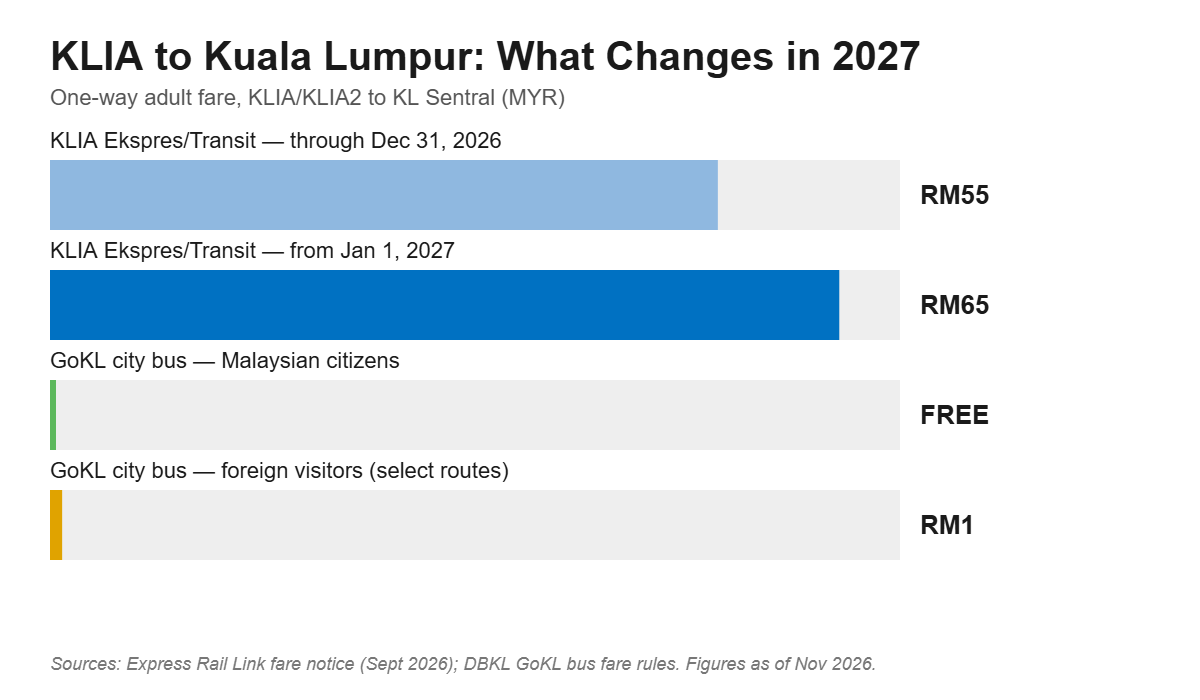
Malaysia’s Express Rail Link quietly confirmed in September 2026 that the one-way adult fare on the KLIA Ekspres and KLIA Transit trains is rising from RM55 to RM65 — an 18% increase — effective January 1, 2027. It’s the first change to a fare that had been frozen since 2016. If you’re flying into Kuala Lumpur International Airport after New Year’s, the 28-minute non-stop ride from KLIA into KL Sentral will cost a family of four roughly RM260 one-way instead of RM220, which is enough to make the city bus or a shared ride worth a second look before you default to the train out of habit.
The train isn’t the only option. A metered taxi from the airport taxi counter or a Grab booked on arrival covers the same roughly 50 km route in 45–60 minutes depending on traffic, lands within a similar price range to the new train fare once the airport surcharge is added, and — unlike the train — drops you at your hotel door instead of at KL Sentral, where most visitors still need a second ride. If your hotel sits near the Petronas Towers or Bukit Bintang rather than right at KL Sentral, that second leg is worth pricing in before you assume the train is the cheaper choice.
Once you’re past the airport transfer, Kuala Lumpur is a largely cashless, card-tapping city: a Touch ‘n Go card, sold at any LRT, MRT or monorail station counter, covers rail fares, tolls and even some parking, and is worth buying on arrival instead of queuing for single-trip tokens at every station. The ringgit (RM/MYR) is the only currency anyone uses day to day; airport currency counters are fine for a small amount of cash to get started, but most hotels, malls and even the hawker stalls below increasingly accept cards or e-wallets.
The “Free” Bus That Isn’t Free for Everyone
Once you’re in the city, getting around doesn’t have to cost anything — if you’re Malaysian. The GoKL City Bus network, run by City Hall (DBKL), has offered free rides on its core routes since 2012. But starting in January 2024, non-citizens have been charged RM1 per ride on an expanding list of routes, with three more routes added to the foreigner-fare list in January 2025. Malaysians keep riding free by registering an IC with tap-and-go function; everyone else taps a card or pays the RM1 at the farebox. It’s a small amount, but it’s worth knowing before you wonder why the fare machine charged you and not the local standing next to you.
What’s Actually Worth the Trip
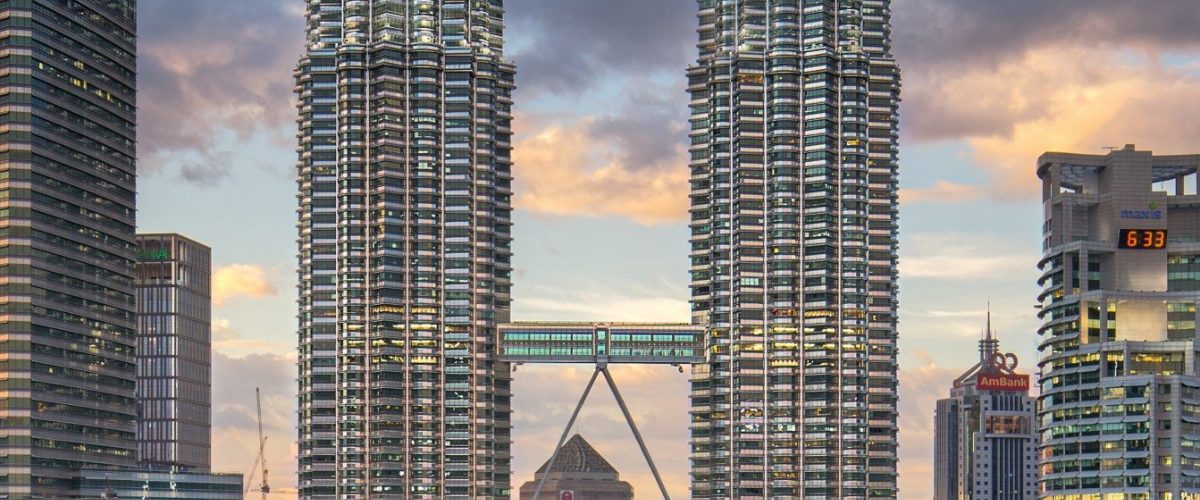
The Petronas Twin Towers are still the reason most people build a Kuala Lumpur stop into a Southeast Asia trip, and they hold up in person. At 451.9 metres and 88 storeys, they remain the world’s tallest twin structures, and the ticketed visit takes you up a high-speed lift to the observation deck on level 86 before routing you across the Skybridge — a two-storey connecting bridge between the towers, 170 metres above the ground, linking their 41st and 42nd floors. Tickets are timed-entry and sell out days in advance in peak season, so this is one attraction worth booking ahead through the tower’s own visitor centre rather than turning up at the counter and hoping.
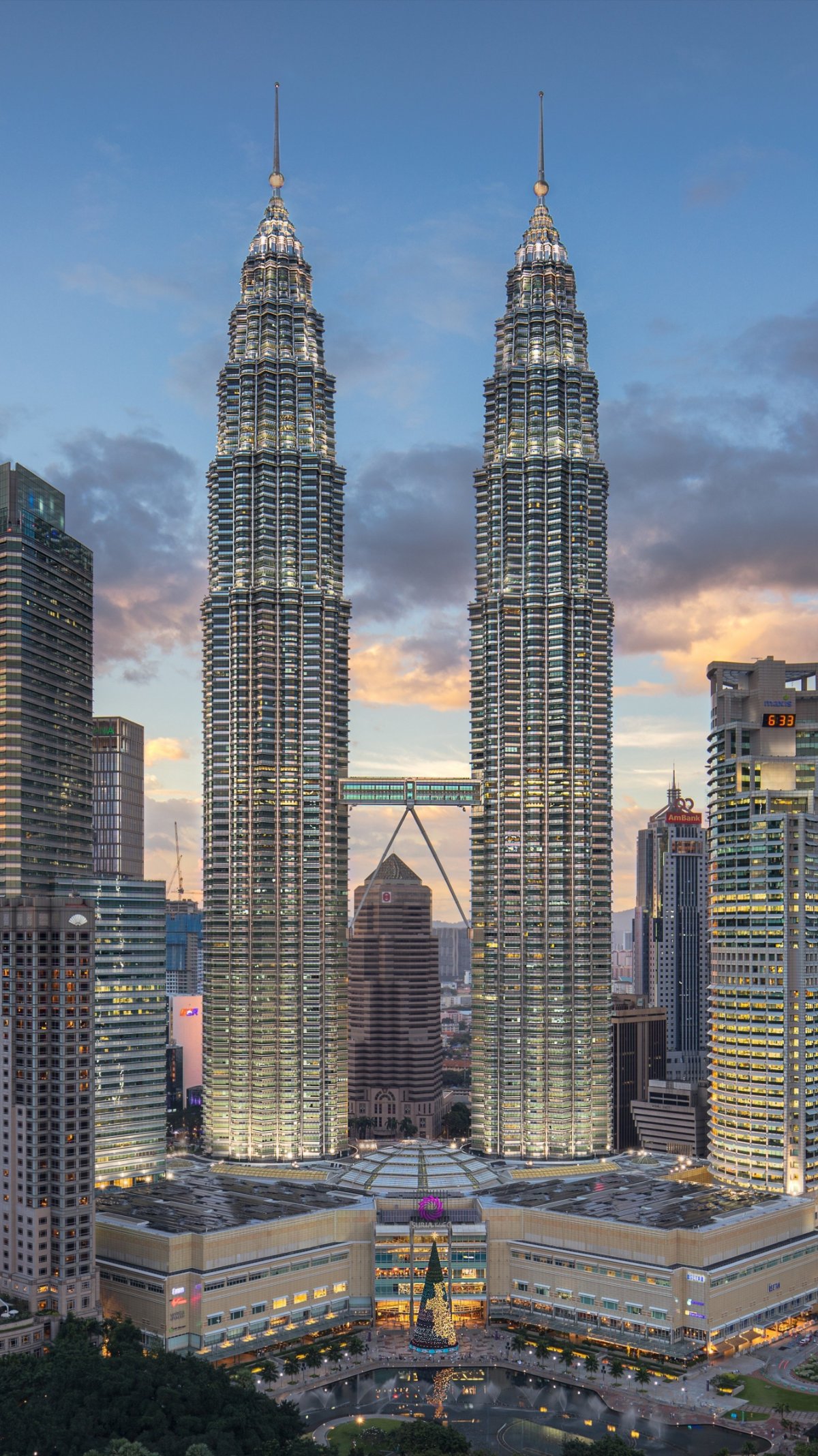
At the base of the towers, KLCC Park is a genuinely useful free stop rather than an afterthought: a landscaped public park built over an underground car park, with a wading pool, jogging track and the best ground-level angle for photographing the towers, especially at the Lake Symphony fountain shows in the evening. It’s also the easiest place to simply sit down with hawker food bought nearby and watch the towers light up without spending anything beyond the meal.
About 13 km north of the city, Batu Caves is the other fixture on every Kuala Lumpur itinerary, and the headline version of it — the limestone Temple Cave at the top of 272 steps — is free to enter. The steps themselves were poured in concrete in 1940, replacing a wooden staircase from 1920, and repainted in a full rainbow gradient in 2018, which is now the single most photographed detail at the site. Guarding the entrance is a 42.7 metre gold statue of Lord Murugan, unveiled in 2006 and still among the tallest Murugan statues anywhere. The Temple Cave and the climb are free; it’s the extras inside the wider complex — the Dark Cave conservation tour and the Cave Villa art galleries — that charge a separate admission, so budget for those only if you want them. Keep food sealed and bags zipped on the way up: the resident long-tailed macaques treat an open hand as an invitation.
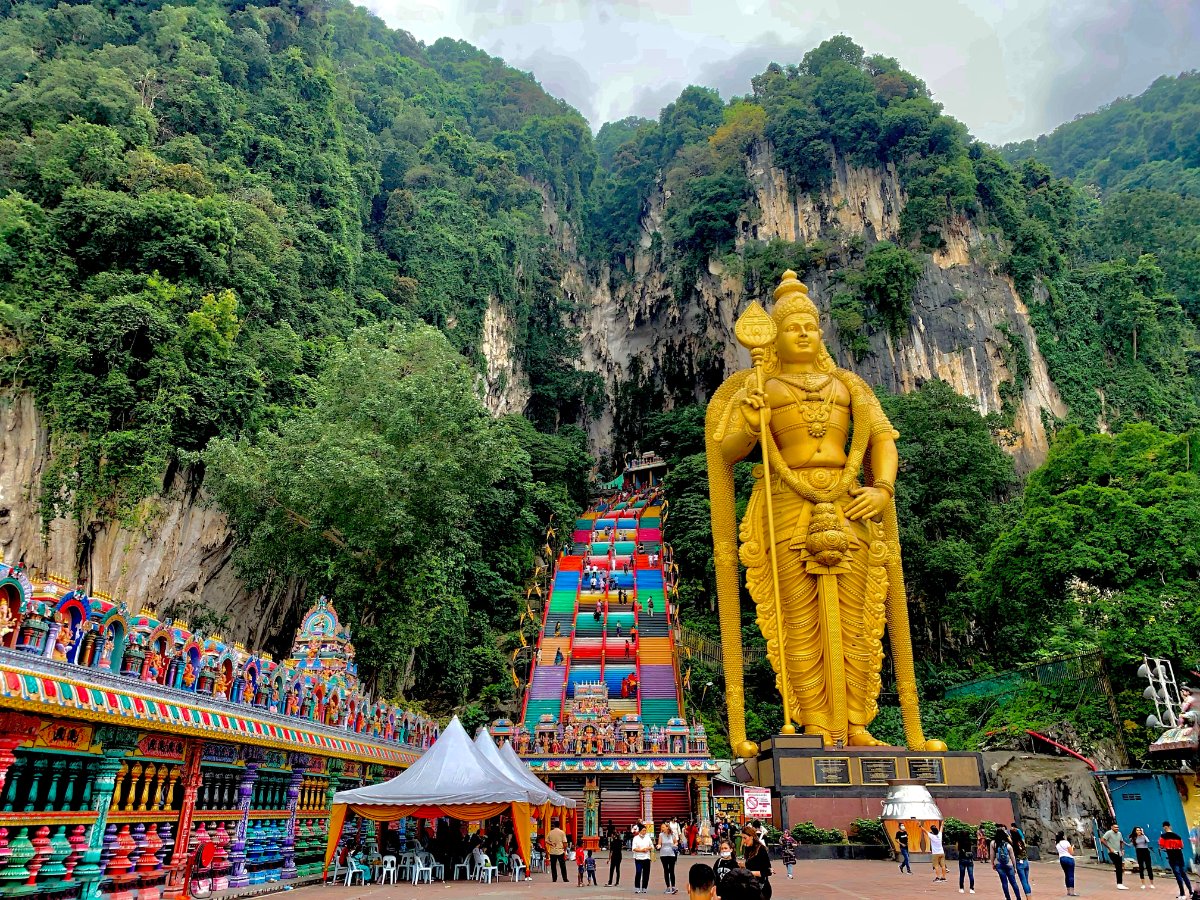
Batu Caves is reached on the KTM Komuter line directly from KL Sentral, so it pairs easily with a morning train ride and an afternoon back in the city centre. Go early — before 9am if you can manage it — both to beat the heat on the uncovered steps and to have the Temple Cave to yourself before the tour buses arrive.
Where to Eat
Kuala Lumpur’s food scene is arguably a stronger reason to visit than either landmark above, and almost none of it requires a reservation. Jalan Alor in Bukit Bintang turns into an open-air night market every evening, with grilled seafood, satay and claypot dishes served at plastic tables set up directly on the street. For a sit-down version of the same Malaysian-Chinese-Malay mix, look for nasi lemak (coconut rice with sambal, anchovies and egg, technically a breakfast dish that Malaysians eat all day), bak kut teh (a pork rib and herb soup, best known from nearby Klang), and roti canai with dhal for a cheap, filling breakfast at any mamak (24-hour Indian-Muslim) stall. Central Market and the Petaling Street night market in Chinatown are the more touristy, English-menu versions of the same food culture, worth a visit for souvenirs more than for the most authentic plate in the city.
Where to Base Yourself
Most first-time visitors choose between two areas. The KLCC district puts you within walking distance of the Petronas Towers, KLCC Park, and the Suria KLCC mall, and it’s the most straightforward base if sightseeing matters more than nightlife. Bukit Bintang is louder and more street-level — this is where Jalan Alor’s night food stalls and most of the city’s bar and club scene live — and it’s a short monorail or Grab ride from KLCC rather than a walk. Both areas have hundreds of rated options on Booking.com; compare live prices for your dates below rather than relying on a “best hotel” list that was accurate six months ago.
See Hotels Near KLCC on Booking.com →
See Hotels in Bukit Bintang on Booking.com →
Comparing Flights to Kuala Lumpur
KLIA is the main international gateway, with a dedicated low-cost terminal (klia2) a short hop away by the same KLIA Ekspres and KLIA Transit lines above — check which terminal your airline actually uses before you plan your transfer, since AirAsia and most budget carriers use klia2, not the main terminal. Malaysia’s position in the middle of Southeast Asia also makes Kuala Lumpur one of the cheaper hubs for stitching together a wider regional trip — through Bangkok, Hanoi or Chiang Mai — on the same ticket rather than booking each leg separately. Compare live fares into Kuala Lumpur below before locking in dates.
When to Go
Kuala Lumpur sits on the peninsula’s west coast, which is sheltered from the worst of the Northeast Monsoon that floods the east coast states between November and March — but “sheltered” doesn’t mean dry. This is an equatorial city, and a short, heavy afternoon thunderstorm is a near-daily possibility in any month, so pack for rain regardless of when you book. Treat any “best season” claim, including this one, with a healthy amount of skepticism and pack a compact umbrella instead of chasing a dry week that may not materialise.
Quick Reference
- KLIA Ekspres / KLIA Transit, KLIA–KL Sentral: RM55 through December 31, 2026; RM65 from January 1, 2027.
- GoKL city bus: free for Malaysian citizens; RM1 per ride for foreign visitors on an expanding list of routes since January 2024.
- Petronas Twin Towers: timed-entry tickets, book ahead in peak season.
- Batu Caves Temple Cave: free; the Dark Cave and Cave Villa extras inside the complex are paid separately.
- Get a Touch ‘n Go card on day one for rail transit and tolls instead of single-trip tickets.
- Rain is possible in Kuala Lumpur in every month of the year — pack for an afternoon downpour regardless of when you go.
See It Before You Go
Kuala Lumpur rarely gets more than a one- or two-night stopover on a Southeast Asia itinerary built around Bangkok, Hanoi or Bali, and that’s a mistake the fare hike above doesn’t change: between the towers, the caves, and food that doesn’t require a reservation or a translation app, it earns a longer look than most routing tools give it by default.