
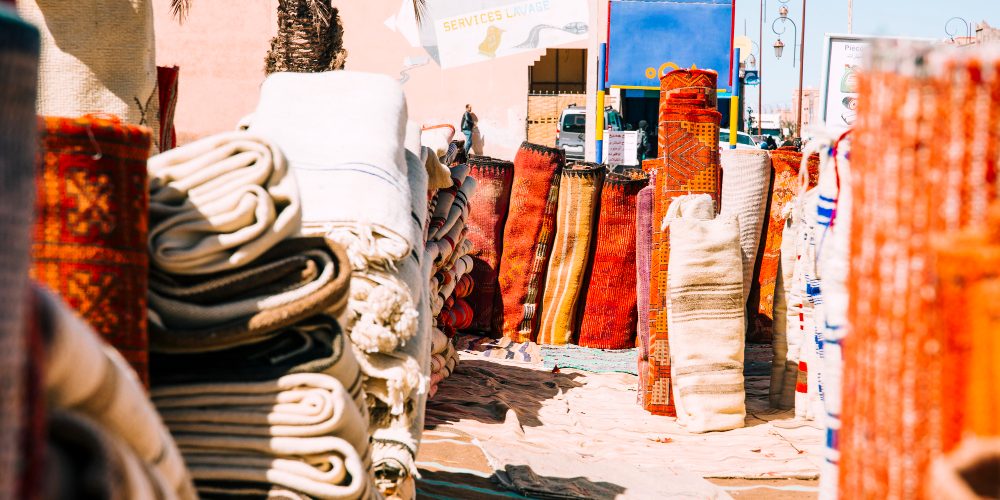
Marrakech Menara Airport sits barely six kilometres from the walls of the Medina. On a clear road the drive takes fifteen minutes. And yet this short hop generates more arguments, overcharging stories and bad first impressions than almost any airport run in North Africa. The reason is simple: there’s an official price, and there’s the price quoted to tired travelers who just landed. Here’s how the game works in 2026 — and three ways to skip playing it entirely.
The official taxi price vs. the quoted one

The regulated daytime fare from Menara Airport to the Medina or Guéliz is posted on a board outside arrivals: around 70–100 dirhams ($7–10) for the car, not per person, with a roughly 50% supplement after 8 pm. What you’ll actually be quoted at the kerb is 200, 250, sometimes 300 dirhams — delivered with total confidence and a laminated “official tariff” card of mysterious origin.
You have three options: negotiate (start at 70, settle around 100 daytime and feel fine about it), walk 200 metres past the terminal fence where fares drop sharply for the same cars, or remove the negotiation entirely by pre-booking. After a red-eye with luggage and kids, the third option wins.
Option 1: Pre-booked private transfer — the zero-drama choice
A pre-booked car with a name board in arrivals costs about €12–20 to anywhere in central Marrakech — often less than what a kerbside taxi ends up extracting, and the price is fixed before you fly. The driver tracks your flight, waits if you’re delayed, and knows which Medina gate is closest to your riad (more on that below). You can get fixed-price transfer quotes for your arrival here — bids typically come in within minutes and you pick the car class you want.
If you would rather have a fixed price agreed in advance and a driver waiting in arrivals with your name on a sign, a pre-booked private transfer removes both the queue and the fare negotiation:
Option 2: The No. 19 airport bus — 30 dirhams, honestly fine
The official airport shuttle (line 19) runs roughly every 20–30 minutes from just outside arrivals, loops past Jemaa el-Fnaa and up through Guéliz, and costs 30 dirhams single or 50 return, with the return leg valid for two weeks. It takes 20–30 minutes depending on traffic. If you’re traveling light, arriving in daylight, and your riad is near the square, it’s the best value in the city. It does not run late at night — check the last departure if you land in the evening.
Option 3: Ride-hailing — yes, but know the rules
Uber doesn’t operate in Morocco. Careem and inDrive do work in Marrakech, with fares to the Medina usually 60–90 dirhams, but drivers can’t legally pick up inside the airport zone, so they’ll message you to walk to a meeting point outside the perimeter. It works; it’s just not elegant with a luggage trolley. For the return trip to the airport from the city, ride-hailing is much smoother.
The part nobody warns you about: the last 300 metres
Here’s the detail that catches almost every first-timer. Most Marrakech accommodation is a riad inside the Medina — and the Medina is car-free. No taxi, however honest, can drive to your door. You’ll be dropped at the nearest gate (Bab), and the final stretch is on foot through alleys that all look identical. Three survival tips:
- Email your riad your arrival time — most will send a porter to meet you at the gate for 20–50 dirhams. Worth every centime.
- Download the offline map of Marrakech before you land; GPS works in the alleys even without data.
- Politely ignore unofficial “guides” who materialise to walk you in; agree a price first or decline clearly, otherwise a tip will be demanded on arrival.
If you haven’t booked yet, it’s worth filtering for riads within a short walk of a major gate like Bab Doukkala or near Jemaa el-Fnaa — browse Medina riads and their exact locations here and check the map view before committing.
Cash, SIMs and the arrivals hall
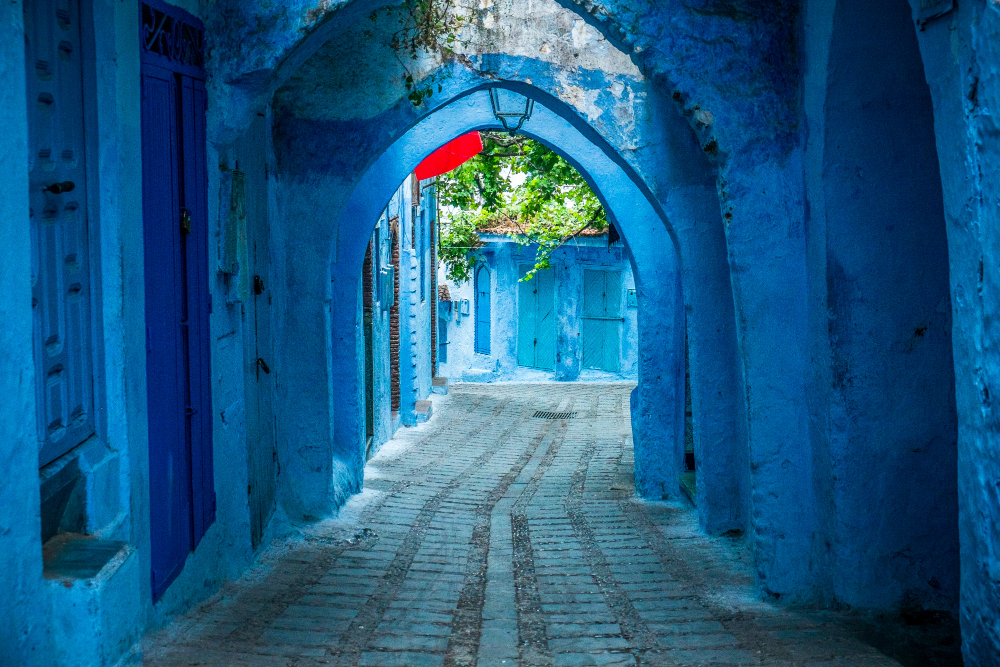
Dirhams are a closed currency — you can’t get them abroad, so the airport ATMs (in arrivals, after customs) are your first stop. Take out at least 500 MAD; taxis and porters don’t take cards. The currency exchange desks at Menara offer noticeably worse rates than the ATMs. Skip the airport SIM card queue entirely by installing an eSIM for Morocco before you fly — you’ll have data the moment the wheels touch down, which matters when your driver is messaging you a meeting point.
Getting back, and getting around after
For the return to Menara, book your car the evening before — morning traffic around the Medina walls is slow between 8 and 10 am, and the airport recommends arriving 3 hours early for international departures in high season. Once you’re settled in the city, petit taxis (the beige ones) are cheap for hops around town: insist on the meter (“le compteur, s’il vous plaît”) or agree a price first. Feeling more adventurous? Renting a motorcycle in Marrakech opens up the Agafay desert and the Ourika Valley, and domestic flights within Morocco make Fes and Tangier easy side trips.
Bottom line
Fifteen minutes and six kilometres shouldn’t require a strategy document, but Marrakech is Marrakech. Pay around 100 dirhams for a kerbside taxi and call it fair, take the 30-dirham bus if you’re light and early, or lock in a fixed-price transfer before you fly and spend your first Moroccan hour drinking mint tea on a rooftop instead of haggling in a car park. Use the flight search below if you’re still comparing arrival options and dates.
If your plans reach beyond the city itself, hiring a car is usually cheaper than repeated transfers — compare rates here:
The three classic Marrakech arrival scams — and their antidotes
“Your riad is closed.” A helpful stranger near the gate informs you your riad has shut down, burned, or moved — but he knows a better one (paying him commission). The riad is fine. Say thanks, keep walking, call your host if pestered.
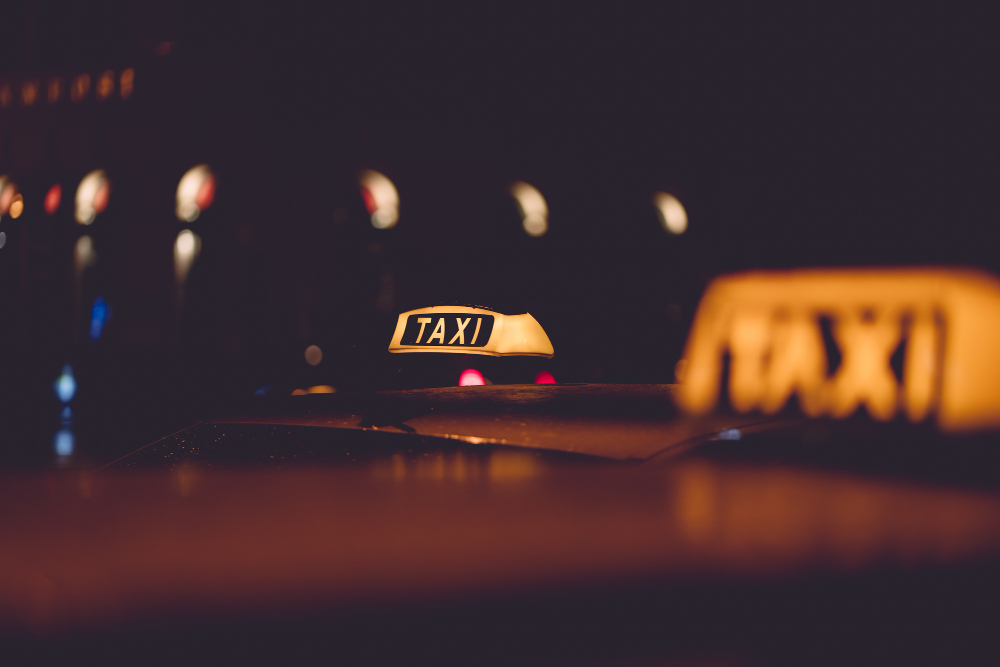
The broken meter. Petit taxi meters in Marrakech mysteriously malfunction the moment a tourist opens the door. The legal move is the meter; the practical move when it’s “broken” is agreeing the full price before the wheels move — around town runs shouldn’t exceed 20–50 dirhams by day. If the driver waves you in with “we’ll sort it later,” you won’t like later.
The luggage relay. At the airport kerb, an unrequested helper grabs your bags into the taxi, then demands 50 dirhams for the service. Keep a hand on your own luggage and a friendly, firm “la, shukran” (no, thank you) does the rest.
None of this should put you off — Marrakech’s hustle is theatre with a price list, and locals deal with the same games. Once you know the script, it becomes almost fun to decline your lines.
Worth knowing for the rest of the trip
The airport run is also your first data point for trips beyond the city. A grand taxi (shared Mercedes) to the Ourika Valley costs around 50 dirhams a seat; a private day round-trip to Essaouira runs 800–1,200 dirhams after negotiation, while the Supratours bus does it for 100 each way in comfort. For the Atlas passes and the desert road to Aït Benhaddou, a pre-booked driver or a small-group tour beats city taxis on both price and vehicle quality — the same transfer platforms that cover the airport handle intercity runs, so a quote costs nothing. However you leave town, carry small notes: nobody in Morocco ever has change, a national mystery that has survived every government since independence.


Add comment