A scooter in Santorini costs less than lunch. Fifty-cc mopeds start around €12–€25 a day in shoulder season and a 125cc runs roughly €25–€45. That price is why almost every visitor considers one, and it is also why almost nobody researches the part that actually matters.
The thing that stops people renting in Santorini is not money and not availability. It is the plastic card in their wallet. Greece has a specific, strictly-read set of licence categories, and a large share of visitors — particularly Americans, Australians, Canadians and Britons who have ridden 125s at home without a second thought — arrive holding a document that does not legally permit them to ride anything at all on the island. Rental shops vary in how carefully they check. Police checkpoints and, far more importantly, insurers do not vary at all.
Here are the five rules that decide whether you ride, in the order they will actually affect you.
Rule 1: a car licence is not a scooter licence in Greece
This is the big one, and it is where the internet is most confidently wrong.
In Greece, riding a scooter of any engine size requires a motorcycle entitlement printed on your licence. For anything up to 125cc you need category A1, A2 or full A. For 150cc–200cc machines you need A2 or A. Even a 50cc moped requires an AM entitlement. A plain category B car licence, on its own, is not sufficient.
The confusion comes from a domestic concession that exists in several countries — including Greece itself — where holders of a national car licence with a few years’ experience may ride a 125 at home. That concession is national. It does not travel. If your licence card does not physically show A1, A2, A or AM in the categories table on the back, you do not have the entitlement in Greece, regardless of what you are allowed to ride in your own country.
Practical consequences, in descending order of how much they will ruin your holiday: your insurance is void in an accident; you can be fined at a roadside check; and the rental company can refuse you at the counter after you have already paid a deposit.
Rule 2: EU and UK licences are accepted as-is; everyone else needs an IDP
National driving licences issued in the EU and the UK are recognised in Greece without further paperwork, provided the correct category is on the card.
Visitors from everywhere else — the United States, Canada, Australia, New Zealand, South Africa and most of Asia — need to carry an International Driving Permit alongside their home licence. The IDP is a translation booklet, not a licence in its own right: it confers nothing your home licence does not already grant. If your home licence has no motorcycle entitlement, an IDP will not create one.
Two details that catch people out. The IDP must be obtained in your home country before you travel — you cannot get one in Greece. And most rental agreements also require that your licence was issued at least one year before the pickup date, which quietly excludes anyone who passed their test recently.
Carry the original card. Photographs and photocopies are routinely refused.
Rule 3: the helmet rules tightened, and more change is proposed for 2026
Helmets are mandatory in Greece and the fine for riding without one is steep — in the region of €350. It is enforced, and enforced on tourists.
Following a run of serious accidents involving visitors on rented quads and scooters, the Greek government moved in 2026 to tighten the rental rules further. The proposals reported so far would prohibit rental companies from handing over a motorcycle, scooter or quad without also supplying a helmet, require operators to verify customers’ licence categories at the counter, and — the significant one — raise the minimum licence-holding period to five years for quad bike hire, up from the current one year.
Two important caveats. As of the middle of 2026 this is a proposal rather than settled law, and the rental industry has pushed back hard, having already taken bookings and bought vehicles for the season. And the five-year rule as reported applies to quad bikes specifically, not necessarily to two-wheeled scooters. Check the current position with your rental company at the time you book rather than relying on any article, including this one.
What is not in doubt is the direction of travel. Greece is tightening, not loosening, and the era of being handed keys after a glance at a driving licence is closing.
Rule 4: Santorini is a genuinely difficult island to ride
This is the rule nobody writes about, because it does not fit the photograph.
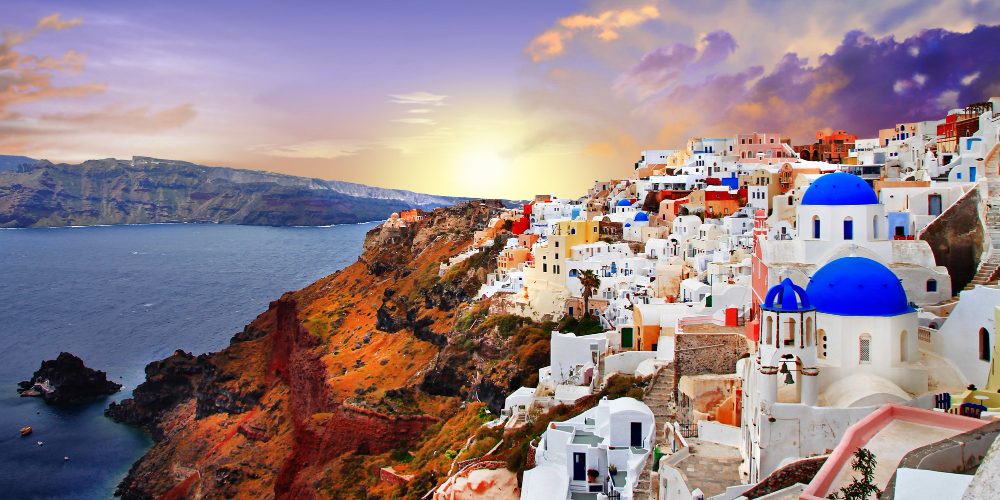
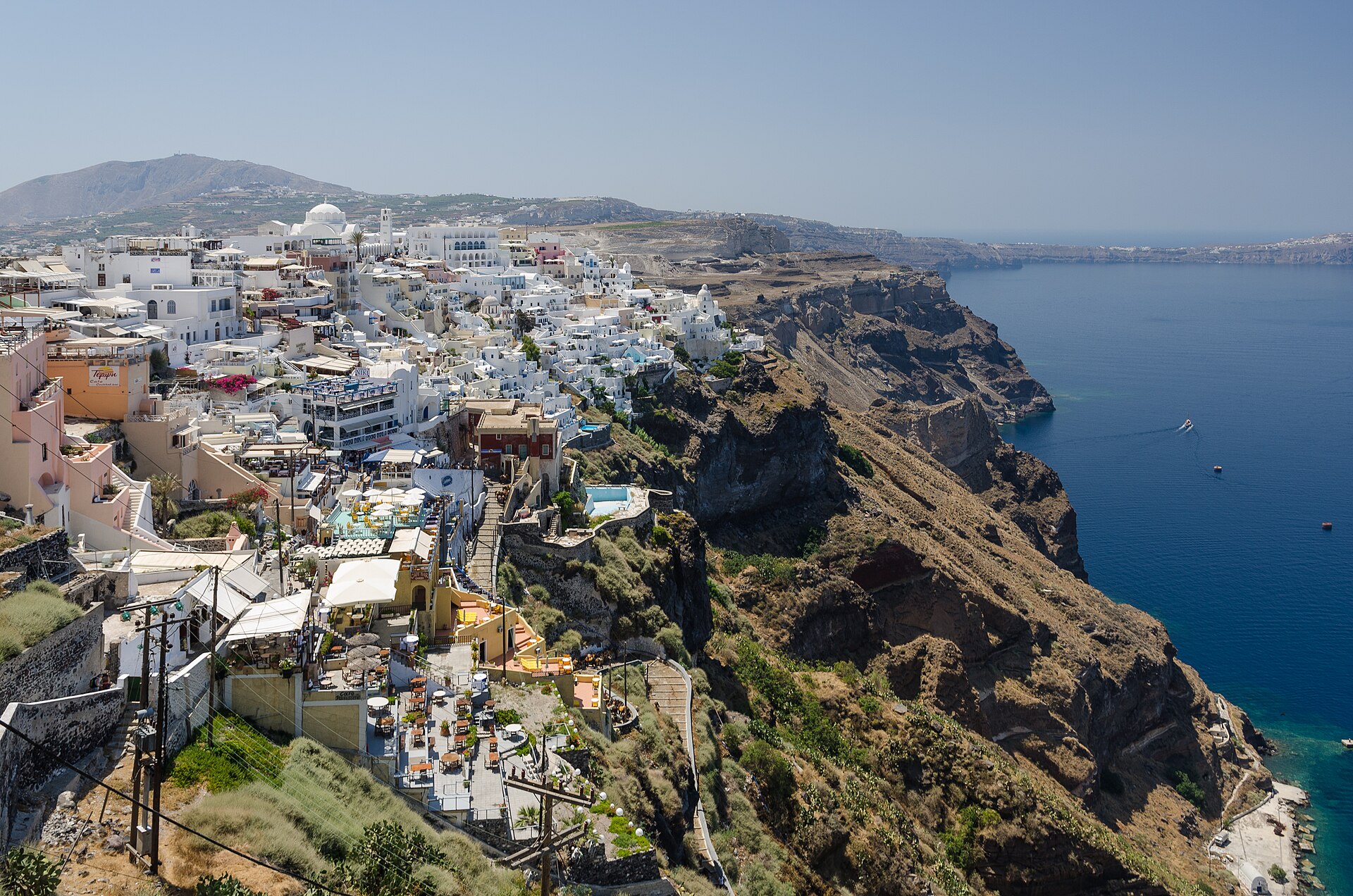
Santorini is the rim of a collapsed volcano. The inhabited western edge is a crescent of cliff standing several hundred metres above the sea, and the roads that serve it climb, switchback and drop in ways that would be unremarkable in a car and are demanding on a 50cc moped carrying two people. The main Fira–Oia road is the busiest stretch, shared with coaches, quad convoys and hire cars driven by people also on unfamiliar roads.
Then there is the wind. The meltemi blows through the Cyclades from roughly June to September, and on the exposed caldera road a strong gust hits a lightweight scooter like a shove. It is the single most underestimated hazard on the island.
Add to that: gravel and volcanic grit washed onto bends, extremely limited parking in Fira and Oia at peak times, and — in high season — traffic density on an island road network built for a fraction of the current load. A 50cc struggling uphill in that environment is not a relaxing way to see the caldera.
The honest recommendation: if you are an experienced rider, a 125cc is a genuinely excellent way to get around Santorini, and it solves the parking problem better than anything else. If you have never ridden before, Santorini is close to the worst island in Greece to learn on. Rent on Naxos or Paros instead, and take a car or the bus here.
Rule 5: know what the insurance actually covers
Basic third-party cover is included in essentially every rental on the island. What it does not include is the part that costs money.
The standard package typically leaves you liable for damage to the scooter itself, and rental shops usually take a credit card deposit against it. Optional damage waivers are sold at the counter for a few euros a day. Before you decline one, ask three specific questions: what is the excess in euros, does the waiver cover the underside and the fairings (the parts that actually get damaged in a low-speed drop), and is theft included.
And the point that ties this article together: every one of these policies is void if you were not legally entitled to ride. A rider on a 125 with only a car licence who drops the bike on a gravel bend is not covered for the scooter, not covered for their own injuries, and not covered for anyone else’s. That is the real cost of the licence question, and it is why it is worth more attention than the daily rate.
Check also whether your travel insurance excludes motorcycle use — a great many policies do, or require a helmet and a valid licence as an explicit condition.
When a car is the better call
A scooter wins on parking and on the pleasure of the ride. A car wins on almost everything else, and there are four situations where it is not a close contest: you are travelling with luggage between accommodation; you are three or more people; you are visiting between November and March, when rain and wind make the caldera road genuinely unpleasant; or nobody in the group holds a motorcycle entitlement.
Santorini is small — about 18 km end to end — so a car is cheap to run here, and the fuel bill for a week is trivial either way. The real trade-off is parking in Fira and Oia in July and August, which is difficult and occasionally impossible. If your accommodation includes a parking space, take the car.
Where you sleep decides how much you need to ride
This matters more on Santorini than on most islands, because the island’s two centres of gravity are 11 km apart and the bus network runs through Fira as a hub rather than between villages.
Fira is the transport centre: every bus route touches it, and from here you can reach most of the island without your own vehicle at all. It is also the noisiest and the most crowded.
Oia is the postcard, and the sunset crush is real. Staying here means you are already in place when the day-trippers leave, but you are 11 km from the bus hub and parking is at its worst.
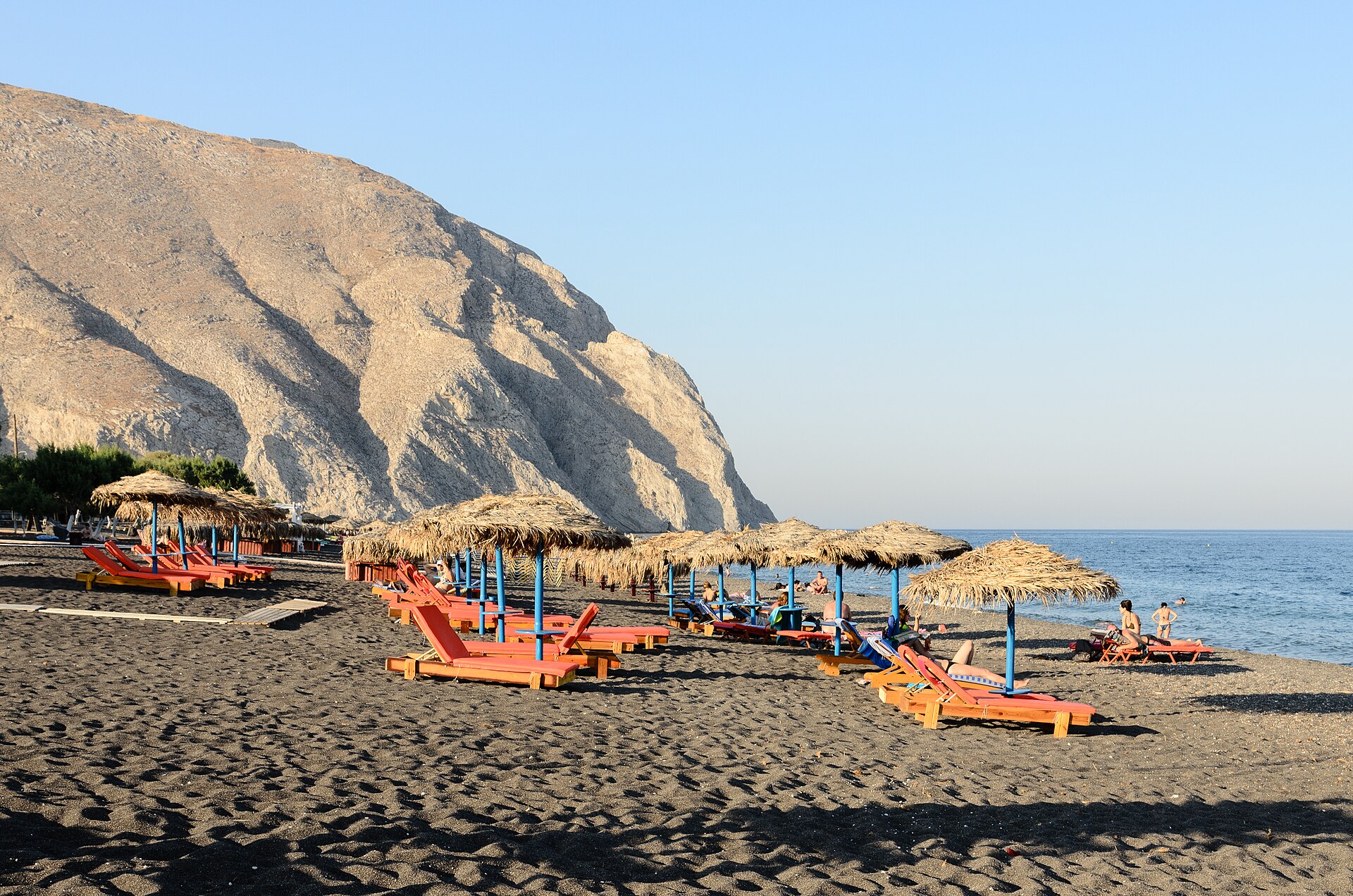
Perissa, Perivolos and Kamari on the south-east coast are flatter, cheaper, have the beaches, and are the sensible base if you intend to ride — the roads on this side are far gentler and you avoid the caldera commute in both directions.
Pyrgos and Megalochori in the middle are quiet, central and the best compromise if you have your own transport.
What to book before you arrive
Santorini’s genuinely limited-capacity experiences sell out in high season in a way the island’s restaurants and beaches do not.
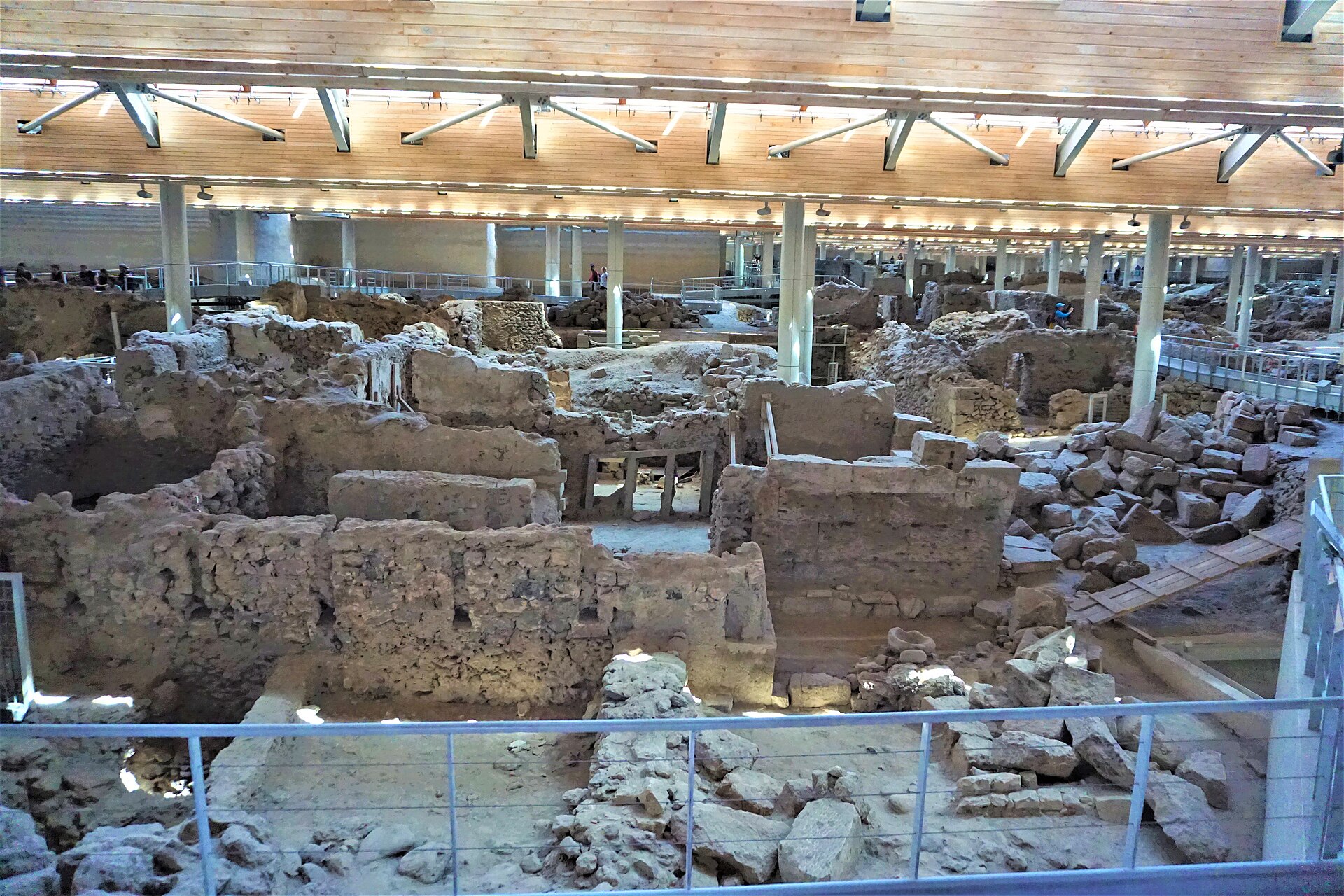
Akrotiri is the one to prioritise. It is a Bronze Age town buried by the eruption around 1600 BC and excavated under a modern shelter — streets, two- and three-storey buildings and drainage systems preserved to an extraordinary degree, and unlike Pompeii, no bodies, because the population appears to have evacuated in time. It is the most interesting thing on the island by a wide margin and a fraction of the visitors bother.
Also worth booking ahead: caldera catamaran cruises, which are capacity-limited and the best way to see the cliff from below; the Ancient Thera site on the mountain between Kamari and Perissa; and wine tastings at the island’s assyrtiko producers, where the vines are trained in low woven baskets called koulara to shelter the grapes from that same meltemi wind.
Getting here, and the 2026 crowd rules

Two changes to Santorini’s visitor management are now in force and both affect how the island feels day to day.
A daily cruise passenger cap of 8,000 applies, enforced through a ranked berth allocation system rather than at the gangway — calls that exceed the cap get moved to other dates. For 2026 the occupancy assumption used in the calculation rose to 100%, which tightens it further: a 3,000-berth ship now consumes 3,000 slots rather than an estimated 2,400. Scheduled cruise arrivals for 2026 are down about 18% year on year, at roughly 595 ships against 728 in 2025.
There is also a cruise passenger levy. From 1 June to 30 September it is €20 per person to step ashore at Santorini and Mykonos, against €5 at other Greek ports. In the shoulder windows of 1 April to 31 May and through October it drops to €12, and in winter to €4. It is charged to cruise passengers, not to people arriving by ferry or air.
The practical upshot for a rider: the mid-morning to late-afternoon congestion that made the Fira–Oia road unpleasant is measurably easing, but it is still concentrated in that window. Ride early or ride late.
A route worth doing
The best half-day on two wheels does not go to Oia. Start in Fira, drop south-east to Kamari, climb the switchbacks to Ancient Thera on the saddle of Mesa Vouno, come down the other side to Perissa, then cut west through Emporio and Megalochori to Akrotiri and the lighthouse at the island’s southern tip. It is about 40 km, the roads are quieter, the gradients are manageable, and it takes in the two archaeological sites and the black-sand coast.
Save Oia for the evening bus, when you will not be trying to park.
Practical notes
- Fuel stations cluster around Fira and the Karterados junction; there are few on the caldera road. Fill up before a long loop.
- Riding is on the right. Obvious, but the first ten minutes matter.
- Two on a 50cc is legal but genuinely slow uphill. If there are two of you, pay the extra for a 125.
- Photograph the scooter from all sides before you leave the shop, including the underside of the fairing. Damage disputes are the most common complaint on the island.
- Sun. There is no shade on the road and a rider gets a great deal more exposure than they expect. Long sleeves are more comfortable than they sound.
- Ferry travel with a rented scooter is not permitted — rentals stay on the island.
Further reading
- Scooter rental in Phuket — the same licence question, a very different enforcement culture.
- Things to do in Athens — the usual gateway to the Cyclades.
- Scooter rental in Da Nang — for comparison on insurance and deposits.
- Choosing a travel eSIM — useful for offline maps when the caldera road eats your signal.