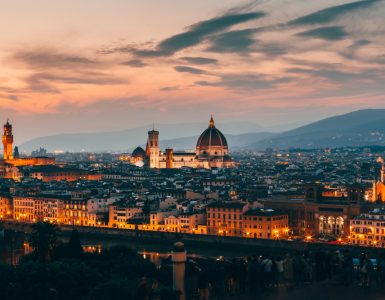
The most valuable thing a rented scooter buys you in Florence is the ability to leave it. The historic centre — the Duomo, the Signoria, the Ponte Vecchio, the reason anyone comes — is either fully pedestrianised or sits inside a camera-enforced limited traffic zone for most of the working week, and no tourist permit lets you in. Florence rental economics therefore run backwards from what people expect: you book a small city machine imagining Roman Holiday, and the value only begins once the city is behind you. Knowing that before you pay is the difference between a good three days and a stack of penalty notices arriving at home in November.
What two wheels can and cannot reach in the centre
Florence’s ZTL — zona a traffico limitato — covers essentially the whole historic core, divided into sectors A, B and O, with additional F and G sectors that activate for the summer night restriction. Every entry point, or varco, carries a camera that photographs plates and checks them against a whitelist. The published exemptions are residents with permits, permit-holding businesses, taxis, buses, and hotel guests whose plate the hotel has registered in advance. There is no general two-wheeler exemption in the rules, and a scooter carries a plate like anything else. Do not assume you are invisible because you are on two wheels.
Sector A, the tightest ring at the heart of the old city, is closed at all times to anyone without a specifically A-rated permit — a B or O permit will not get you in. Separately from the ZTL altogether, the areas around Piazza del Duomo, Via Tornabuoni, Piazza della Signoria and Piazza Pitti are pedestrian-only during the day. A scooter does not change that arithmetic.

The ZTL clock, and the summer exception nobody reads
The baseline hours are straightforward enough. The zone is active weekdays from 07:30 to 20:00 and Saturdays from 07:30 to 16:00. Outside those windows — after 8pm on weekdays, after 4pm on Saturday, and all day Sunday — the zone opens to everyone.
The exception that catches visitors is the summer night ZTL. From the first Thursday in April until the first Sunday in October, the zone reactivates on Thursday, Friday and Saturday nights from 23:00 to 03:00 — and during those hours it is extended beyond the daytime boundary to cover the additional F and G sectors. So a Friday evening ride into town at nine is legal; the same ride home at half past eleven, by the same streets, is not.
Reported fines vary by source. Figures published for 2026 cluster around €80–€83 per camera crossing, with a wider quoted band running to roughly €330 depending on the code applied. The multiplier matters more than the figure: cross cameras in two sectors on one trip and you generate two separate penalties. Check the Comune di Firenze map and current tariff rather than trusting any summary, including this one.
The trap with no off-hours: reserved lanes
This one is worth more than the ZTL section, because almost nobody warns about it. Florence has corsie riservate — lanes reserved for buses, taxis, ambulances, police and a short list of others — and they are scattered across the entire city, well outside the ZTL boundary. Unlike the ZTL, they have no off-hours at all. They are enforced twenty-four hours a day, seven days a week.
They are marked with plain red “do not enter” discs carrying no words, which visitors from countries that print text on their signs routinely misread. The classic mistake is following a taxi or a bus through a junction, because the taxi is allowed and you are not. Residents report still being caught in parts of the city they rarely drive.
Where you sleep decides whether the scooter is worth it at all. Inside the ZTL a rental is a liability; a base just outside the ring — Oltrarno, Campo di Marte, or across the river toward Fiesole — turns it into the right tool. Compare before you commit to dates.
What the machines cost — and the 80-kilometre catch
Florence is a cheap city to hire a small scooter in, which is part of why the mileage terms are so easy to miss. Listed daily rates on the aggregator platforms start around €30 for an electric Vespa 50 and €35 for a Honda SH 125 or an electric Vespa 70. From there: roughly €40 for a Honda Vision 110, a Piaggio Liberty 125 or a Vespa Primavera 125; about €45 for a Vespa Primavera 150, a Honda SH125 Mode, a SYM Symphony S 125 or a BMW G310R; and around €70–€75 for a Vespa GTS 300.
Then read the small print. A common Florence full-day package includes the machine, one helmet and roadside assistance, with a distance allowance of 80 km and €0.25 per kilometre beyond it. The day itself is often short — collection from 9:00, return by 18:30 — not a full twenty-four hours, whatever the listing implies.
Eighty kilometres is the whole problem in one number. It covers Fiesole and back with a wander, and very little else — any Tuscan road that would justify hiring a bike blows straight through it. Some aggregator listings are flagged unlimited mileage, the Vespa Primavera 125, the Piaggio Liberty and the SYM Symphony among them at the time of checking, and that option is usually worth more than a €5 difference in the headline rate.
- Deposit. Commonly €800 for a Vespa and €500 for a smaller scooter, taken as a pending authorisation on a credit card rather than an actual charge. You need the headroom on the card either way.
- Age. Typically 18 minimum, with operators reserving the right to judge whether you can actually ride. Several will refuse you on the spot if you cannot handle the machine in the yard.
- Airport. There is effectively no scooter rental at Florence Airport. The shops cluster in the centre and around the Statuto area, so plan on reaching them by tram, bus or taxi.
- ZTL fines. Ask directly how the operator handles a penalty notice. Rental firms pass your details to the authorities and typically add an administration fee on top of the fine itself.
Your licence: Italy’s 125cc rule belongs to residents, not to you
This is the single most expensive misunderstanding in Italian scooter tourism. Italy does let holders of a full category B car licence ride a 125cc machine of up to 11 kW from the age of 18. That concession is domestic. It applies to Italian licence holders inside Italy, and it does not travel across a border attached to your car licence from home.
For a visiting rider the requirement is the ordinary European one: category AM on your home licence for a 50cc, and category A1 or above for a 125cc. If your licence carries no motorcycle category at all, you are not licensed for the scooter — however cheerfully a rental agent hands you the keys. Riding outside your entitlement is not a technicality: it generally voids the rental insurance and can void your travel insurance too, which converts a low-speed slide into a bill for the machine, the third party and your own hospital treatment.
Non-EU visitors also need an International Driving Permit alongside the home licence. An IDP is only a translation, and it carries just the categories already printed on your licence — a car-only licence produces a car-only IDP. You cannot add a motorcycle category after you land.

Two roads that actually repay the rental
The SR 222, the Chiantigiana. This is the road that makes a Florence hire worth having. It runs south from the city to Siena through the middle of Chianti Classico — vineyards, olive terraces, and a string of hill towns. Taken directly it is roughly 59 km; the version worth riding — looping through Greve in Chianti, Panzano, Castellina, Radda and Gaiole before dropping into Siena — comes to about 69 km one way. An out-and-back day is therefore around 140 km at minimum, comfortably double a standard 80 km allowance. It is a slow road by design, with gradients, blind crests and tractors. Budget a full day.
The SS65 over the Passo della Futa. North instead of south, into the Tuscan-Emilian Apennines. From San Piero a Sieve the climb runs about 43 km and tops out at the Passo della Futa at 903 m, with the Passo della Raticosa at 968 m a further 13 km along the same road. This is the old Futa road, flowing rather than technical, and it is a favourite with Italian riders for exactly that reason. It is also the natural link toward Emilia — if you are continuing that way, our notes on motorbike rental in Bologna pick up at the far end.
Both routes start outside the ZTL and never re-enter it. Plan your exit from the city once, ride it deliberately on the first morning, and most of the trip’s risk disappears.
For the days you leave the bike parked, these are the Florence entries worth booking in advance — the Uffizi and the Accademia in particular are timed-entry, and walk-up queues in summer run to hours.
When you should skip the scooter entirely
Some honest cases where renting is the wrong move, and where we earn nothing by saying so.
- You are staying in the centre for two or three days of sightseeing. Everything you want to see is inside the pedestrian core or the ZTL. Florence is a genuinely small city on foot. A scooter buys you parking problems and camera exposure and very little else.
- You have never ridden a scooter. Traffic is dense, streets are narrow and largely one-way, and signage assumes local knowledge. A poor place for a first lesson.
- Your home licence has no motorcycle category. There is no workaround. Book a driver, a tour, or a bicycle.
- You are travelling between November and March. Tuscan hill roads are cold, wet and often foggy, the Apennine passes can close, and the summer night ZTL is the least of your worries.
If Florence turns out not to be the right base, our broader guide to motorcycle rental in Italy compares the regional options, and the Rome rental guide covers a city with a very different ZTL structure.
One more logistics note: the rental depots are not at the airport, and Peretola is a 20-minute drive from the centre. Book the airport-to-hotel leg separately and collect the scooter the next morning, rested.
Settle these five things at handover
- The kilometre allowance on your specific booking, and the per-kilometre rate above it — then compare it against the route you actually intend to ride.
- The exact return time. A “full day” that ends at 18:30 is not twenty-four hours, and late returns are usually billed as a second day.
- The deposit amount and whether it is an authorisation hold or a charge, so you know what is locked on your card and for how long after return.
- How ZTL and reserved-lane penalties are passed on, and what administration fee the operator adds.
- Photograph every existing scratch with the agent present, before you ride away. On a city scooter this is where deposits go.
Prices checked against operator and aggregator listings in August 2026. ZTL hours, sector boundaries and fine levels are set by the Comune di Firenze and change; published sources disagree on the exact penalty figure, so confirm the current tariff and map with the comune before you ride.


Add comment