For about fifteen years the campervan was Iceland’s answer to Iceland’s prices. Skip the hotels, skip the restaurants, sleep where you stop, and a famously expensive country becomes affordable. That arithmetic no longer works the way it used to. Wild camping has been illegal for campervans since 2015, campsite fees are charged per person rather than per vehicle, a national road tax was added in January 2026, and the insurance products that Iceland’s roads genuinely require add up faster than most people budget for.
None of that means a campervan is a bad idea. It means the reason for choosing one has changed — from saving money to buying flexibility. This guide sets out what a camper actually costs in 2026, what the insurance jargon protects against, where the vehicle can and cannot legally go, and when a rental car plus guesthouses is simply the better trip.
What it costs in 2026
Rental rates move sharply with season and vehicle class. In peak season, roughly June to August, a basic two-berth van without a bathroom sits around €120–180 per day. A four-berth motorhome with a bathroom runs closer to €200–350. Compact 4×4 conversions capable of F-roads start around €139 per day in shoulder season and climb to €180–230 for mid-size pickups, with the highland-capable Sprinter and Crafter conversions at €250–300 and expedition-grade vehicles higher again.
Then come the costs that are not in the headline rate:
- Road tax. Since 1 January 2026 a government road charge of about 1,550 ISK per day — roughly €11 — applies, and it is typically collected at the rental desk on arrival rather than included in the online quote.
- Campsites. Around 1,500–2,500 ISK per person per night, plus a national overnight camping tax of about 400 ISK per vehicle. Showers and electricity are often extra. For two people that is real money every night, not a rounding error.
- Fuel. Among the highest prices in Europe, and the ring road alone is roughly 1,320 km before any detours.
- Insurance. See below. This is where budgets break.
A ten-day trip for two in a basic van, all in, realistically lands well north of what most people first estimate. Run the numbers against a small rental car plus guesthouses before assuming the van wins.
The insurance, translated
Icelandic rental insurance has more acronyms than anywhere else in Europe, and unusually, most of them are not upsell theatre. The hazards are specific and local.
Gravel protection (roughly ISK 1,500–3,000 per day) covers stone chips to paint, windscreen and lights. Iceland’s gravel roads throw stones constantly, and this is the most-claimed item on the island.
Sand and ash protection (roughly ISK 1,000–2,500 per day) covers paint stripped by wind-driven volcanic grit. This is not hypothetical: on the south coast between Vík and Skaftafell, a strong wind can sandblast a vehicle down to bare metal in minutes, and the resulting bill routinely runs into thousands of euros. It is almost never covered by a standard waiver.
Super CDW (around €20–30 per day) reduces a typical €2,500 excess toward zero on non-water damage.
River crossing insurance (around €15–25 per day) matters only if you intend to ford rivers on F-roads — and note that water damage from a failed crossing is excluded from essentially every other policy, including Super CDW. Drowning a rental engine in a glacial river is one of the few ways to owe a rental company the full value of the vehicle.
Where you can legally sleep
This is the rule most visitors get wrong, often because they read an old blog post. Under the Nature Conservation Act, campervans, motorhomes and caravans must overnight at registered campsites, or on private land with the landowner’s explicit permission. Parking in a scenic layby, a trailhead car park or a petrol station forecourt to sleep is not permitted, and enforcement is real — fines commonly start around 50,000 ISK and rise for repeat offences or ground damage.
The practical effect is that a camper trip is a campsite trip. Iceland has a good network of them, most open roughly May to September, with a smaller number operating year-round. The Camping Card — about 26,000 ISK for 2026, covering two adults and up to four children for as many as 28 nights across 40-plus participating sites — pays for itself quickly on a longer trip, though the participating sites skew away from the busiest southern spots.
F-roads: what the 4×4 upgrade actually buys
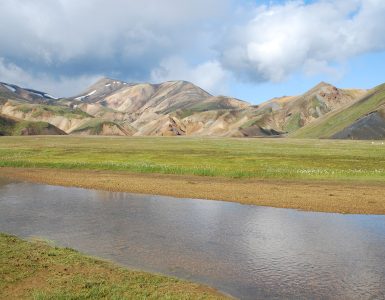
Roads prefixed with “F” are highland tracks, and they are legally restricted to four-wheel-drive vehicles. This is not advisory. Driving a 2WD camper onto an F-road voids your insurance entirely, and rental contracts say so explicitly. The famous destinations behind that restriction — Landmannalaugar, Þórsmörk, Askja, the Kjölur and Sprengisandur routes — are the reason to pay for a 4×4 camper.
Three further points. F-roads open late: many do not open until late June or even July, depending on snowmelt, and the opening dates are published by the Icelandic Road Administration rather than guessable. Many involve unbridged river crossings, where depth changes hour to hour with glacial melt and rainfall. And a 4×4 badge alone does not make a vehicle river-capable — clearance, snorkel or air intake position, and the driver’s experience all matter more than the drivetrain.
If the highlands are not in your plan, a 2WD camper on the ring road and the paved sections of the Snæfellsnes and Westfjords routes is perfectly adequate in summer, and cheaper to rent and to fuel.
When a camper genuinely wins
It wins on flexibility in bad weather. Iceland’s weather does not follow a forecast neatly, and a camper lets you drive away from a system rather than sit out three booked hotel nights in the rain. On a ring road trip in June, that is worth a lot.
It wins in the sparse east and the Westfjords, where accommodation is thin, expensive and books out early, and where a self-contained vehicle removes the planning problem entirely.
It wins for photographers and hikers keeping odd hours — being at a trailhead campsite at 05:00 without a two-hour drive is the whole point.
It does not win in winter, when many campsites close, daylight is short and driving conditions are serious; or on a short four-to-five-day south-coast trip, where you will spend a meaningful share of your time setting up and packing down; or for travellers who want a hot shower and a heated room after a wet day — which is a completely legitimate preference and not a failure of nerve.
The alternative: car plus rooms
Run this comparison honestly before booking. A small 2WD rental car in summer costs a fraction of a camper per day and uses far less fuel. Guesthouses, farm stays and hostels along the ring road are not cheap, but once you have subtracted campsite fees for two people, the camping tax, the higher rental rate and the higher fuel burn, the gap narrows considerably — and you get a shower, a kitchen and a bed you can stand up next to.
If that is the direction you are leaning, our guide to car rental for the Iceland ring road covers vehicle choice and the same insurance questions from the other side. For current room rates along Route 1:
Arriving at Keflavík
Most campervan depots are near Keflavík Airport or in the Reykjavík area, and most will collect you from the terminal. If your flight lands late — a lot of transatlantic and European services do — consider taking a transfer into Reykjavík, sleeping properly, and collecting the vehicle in the morning. Starting a 4×4 camper trip at midnight after a long flight is how first-day mistakes happen.
Practical rules that carry fines or bills
- Off-road driving is illegal anywhere in Iceland, including on visibly compacted tracks across moss. Penalties are severe and moss damage takes decades to recover.
- Headlights on at all times, day and night, by law.
- Hold car doors in wind. Wind-ripped doors are excluded from most policies and are one of the most common expensive claims in Iceland.
- Check road.is and vedur.is every morning. Road closures and wind warnings change daily and are the authoritative source.
- Single-lane bridges and blind rises are common on Route 1. The convention is that the vehicle closer to the bridge goes first; slow down well before it.
- Fuel with a chip-and-PIN card. Unmanned pumps are the norm outside towns and many will not accept a card without a PIN. A working data connection helps with everything else — see our notes on an eSIM for Iceland.
The short answer
Rent a campervan in Iceland because you want to move with the weather, reach trailheads at odd hours, and travel comfortably through the thinly-served east and north. Do not rent one primarily to save money, because between the 2026 road tax, per-person campsite fees, gravel and sand-and-ash cover, and Icelandic fuel prices, the saving is far smaller than the internet still claims — and in a short south-coast trip it may not exist at all.
Further reading
- Car rental for the Iceland ring road
- Domestic flights in Iceland
- Car rental in the Norwegian fjords
- Car rental for the North Coast 500
- eSIM for Iceland