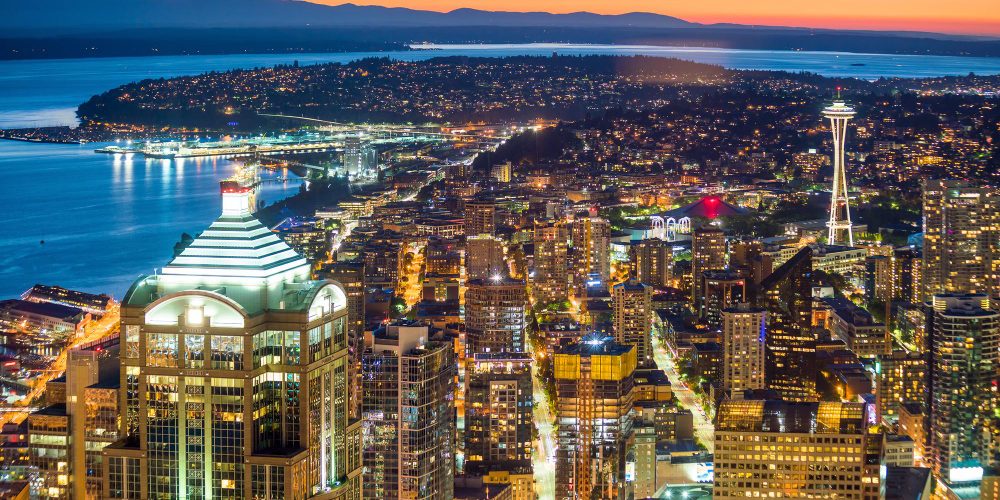
Seattle is one of the very few large American cities where the single best thing you can do costs nothing, the second best costs three dollars, and the headline attractions are worth their money only if you happen to like one specific kind of experience. That is not a criticism of the city. It is the shape of the place. Seattle was built on water and hills, and most of what makes it memorable is weather, geography and light — a ferry crossing at dusk, Mount Rainier appearing over the rooftops on a clear afternoon, the smell of the fish market at seven in the morning. None of that is ticketed.
Which means the practical question for a first visit is not “what should I see” but “what should I actually pay for”. This guide answers that in order: how to get in from the airport, which paid attractions justify the queue, what the multi-attraction passes really cost against buying singles, where to base yourself, and what a sensible three or four days looks like. Prices below were checked in September 2026 and are quoted in US dollars.
Getting in from Sea-Tac without a rental car
Sea-Tac airport sits about 14 miles south of downtown, and the Link light rail 1 Line runs directly between them. The fare is a flat three dollars for an adult, the ride takes roughly 35 to 40 minutes to Westlake in the centre of downtown, and a covered walkway connects the terminal to the SeaTac/Airport station. You can tap a contactless bank card, Apple Pay or Google Pay straight at the reader — an ORCA card is only necessary if you want a reloadable pass or a reduced fare. Children under six travel free with a paying adult, ages six to eighteen pay a reduced fare of about a dollar fifty, and riders 65 and over or on the income-qualified ORCA LIFT programme pay a dollar.
For most visitors that is the whole answer. A taxi or rideshare from the airport will typically run somewhere in the forty-to-seventy dollar range depending on traffic and time of day, and Interstate 5 southbound in the afternoon can turn a twenty-five minute drive into an hour. The train is not merely cheaper, it is often faster. Where a private transfer does earn its keep is late arrivals, a group of four or more splitting the fare, or anyone landing with a lot of luggage and a hotel that is not near a station.

What to book ahead, and what it costs
Seattle rewards booking two things in advance and almost nothing else. The first is the Space Needle, where a timed-entry slot saves you a genuinely long wait on any clear summer afternoon. The second is Chihuly Garden and Glass next door, which is small enough that it sells out of good slots. Everything else in the city can be walked into.
The Space Needle ticket includes both the observation level and the rotating glass floor below it, and the pass version gives you one daytime and one night visit inside a 24-hour window — which is the version worth having, because the view is a completely different thing after dark. Chihuly is the attraction most visitors expect to dislike and then rank first: it is a single artist’s glass work lit in dark rooms and a glasshouse, and it takes about ninety minutes.
Do the passes actually save you money?
Seattle has two bundles and they suit different trips. The full Seattle CityPASS is $139 for an adult and covers five attractions: the Space Needle and the Seattle Aquarium are fixed, and you choose three more from a list that includes Chihuly Garden and Glass, the Argosy Cruises harbour tour, the Museum of Pop Culture, Woodland Park Zoo and the Pacific Science Center. Tickets stay valid for nine days from first use, which matters more than it sounds — you are not forced to cram five attractions into a weekend.
The smaller Seattle C3 is $108 for an adult and $89 for a child aged five to twelve, and lets you pick three attractions from a similar list. The arithmetic is straightforward. If your trip is museum-heavy and you genuinely want the aquarium, the zoo or the science centre — which is to say, if you are travelling with children — the five-attraction pass clears its own cost comfortably. If you are a couple who mainly want the Space Needle, Chihuly and a lot of walking, the three-attraction version fits better, and buying two singles may still be cheaper than either. Both bundles are repriced periodically, so it is worth checking the current Seattle CityPASS price and the three-attraction C3 price against the singles for the specific places you want before committing.
One thing the passes do not solve: they are attraction bundles, not transport passes. Nothing in either includes the light rail, the monorail or the ferries.

The free half of Seattle, which is the better half
Pike Place Market charges nothing and is the most concentrated hour in the city, provided you arrive before nine. The fish throwers are real but they are a small part of it; the market is nine levels of produce stalls, flower sellers, second-hand bookshops and tiny record stores stacked down the hillside, and the lower floors are where the oddities live. By eleven in summer the main arcade is shoulder to shoulder.
Below the market, the rebuilt waterfront promenade now runs continuously from the market stairs down past the aquarium and the ferry terminal — the elevated highway that used to sit there is gone, and the walk is one of the genuine improvements to the city in the last decade. Keep going to Pier 52 and you reach the Washington State Ferries terminal.
The ferry to Bainbridge Island is the three-dollar answer mentioned at the top, or thereabouts: foot passengers pay only westbound, the crossing takes about 35 minutes, and the return leg is free. You get the entire downtown skyline from the water with the Olympic Mountains behind you, and on a clear day Rainier off the stern. A round trip with an hour in Winslow for lunch fills an afternoon and costs less than a museum ticket. Do it late in the day if the forecast is good.

Two more that cost nothing: Kerry Park on Queen Anne hill, which is the postcard view of the skyline with the Needle in front and Rainier behind, best around sunset; and Discovery Park, 500-odd acres of bluff, forest and beach with a lighthouse at the end of a two-mile walk. Both take a bus and neither takes a ticket.
Neighbourhoods, and what each one is for
- Downtown and Belltown — the market, the waterfront and most of the hotels. Convenient, busy, and the part of town that feels least like Seattle.
- Seattle Center and Lower Queen Anne — the Space Needle, Chihuly, MoPOP and the Pacific Science Center in one campus. Worth a full day, not worth basing yourself in.
- Capitol Hill — the best eating and drinking in the city, and where you should go in the evening regardless of where you sleep.
- Ballard — a former fishing town to the northwest, with the locks, a Sunday farmers market and a dense strip of breweries.
- Fremont and Wallingford — low-key, canal-side, home to the troll under the bridge and a good bookshop-and-coffee afternoon.
- Pioneer Square and the International District — the oldest part of the city and the best Asian food in the Pacific Northwest respectively.
A three or four day plan that does not double back
Day one — downtown and the water. Pike Place before nine, then work downhill to the waterfront promenade. Aquarium late morning if it is on your pass, otherwise keep walking to Pier 52 and take the Bainbridge ferry out and back with lunch on the island. Come back into the city for the evening and eat on Capitol Hill.
Day two — Seattle Center. Chihuly first thing, Space Needle timed slot in the early afternoon, MoPOP or the Pacific Science Center to fill the gap depending on whether you want music history or hands-on exhibits. If you bought the day-and-night Needle ticket, come back after dark. The monorail runs from Westlake to the campus in two minutes and is charged separately from the light rail.
Day three — the neighbourhoods. Ballard Locks in the morning to watch boats and salmon move between fresh and salt water, then Fremont for lunch, then Kerry Park for sunset. This is the day that makes people like Seattle rather than merely tick it off.
Day four, if you have it — get out of the city. Mount Rainier National Park is roughly two to two and a half hours south of downtown; Olympic National Park is a ferry plus a drive to the west; the Snoqualmie Falls and the Cascade foothills are under an hour east. All three need a car, and this is the one part of a Seattle trip where public transport genuinely will not do.

Day trips: when to rent a car, and when not to
Do not rent a car for the city itself. Downtown parking runs high, the hills and one-way grid are unpleasant to learn under pressure, and everything above is reachable on foot, on the light rail or on a bus. Rent for the days you leave — most visitors are better off picking the car up downtown on the morning of the day trip and dropping it back that night, rather than paying to park it outside a hotel for a week.
If Rainier is the target, note that the Paradise side has timed-entry reservations in peak summer months and the road over Chinook Pass is closed by snow well into spring. Check the park service page for the current season before you commit to a date.
Where to sleep
Base yourself downtown or in Belltown for a short first trip — you will walk to the market, the waterfront and the light rail, and you can reach Seattle Center on the monorail. Lower Queen Anne is quieter and a reasonable second choice. Capitol Hill suits travellers who care more about the evenings than the sights, and has a light rail station of its own. Ballard and Fremont are pleasant places to stay only if you are happy with a bus ride into town each morning.
Rates swing hard by season. July and August are the peak and prices reflect it; the shoulder months of May, June and September are noticeably cheaper for weather that is only slightly worse. Note also that Seattle hotels commonly charge separately for parking, often thirty to sixty dollars a night, which is another argument for renting a car only on the days you need it.
When to go
The reliable dry window is roughly July through September, and locals will tell you September is the best month of the year — warm, clear and without the August crowds. June is a gamble; the region has a long-standing habit of grey mornings that burn off in the afternoon, or do not. October through May is genuinely wet, though rarely torrentially so; the local rain is a persistent drizzle rather than a downpour, and the city functions normally in it. Winter visitors get cheap hotels, short days and a very good excuse to spend the afternoon indoors at MoPOP.
One weather note worth knowing: Mount Rainier is invisible from Seattle for large parts of the year. When residents say “the mountain is out”, they mean it is a clear enough day to see it, and it is treated as an event. Do not plan a trip around the view.
Practical notes
- Sales tax is added at the till, not shown on the price tag — expect a little over ten per cent on most purchases.
- Tipping runs at the standard US rates; many counter-service places now prompt for it on a screen.
- The light rail, buses, streetcar, monorail and ferries are separate fares. A day of heavy hopping is still cheap, but there is no single all-inclusive visitor pass that covers everything.
- Seattle is hilly in a way photographs hide. The walk from the waterfront up to the market is a genuine climb; there is a lift and a set of stairs, and the lift is the sensible option with luggage.
- Summer evenings stay light until nearly ten o’clock. Winter afternoons are dark by half past four.
Further reading
If Seattle is one stop on a wider Pacific coast trip, our guides to things to do in Vancouver and things to do in San Francisco cover the two obvious neighbours, and the Chicago guide runs the same pass-versus-singles arithmetic for a city where the answer comes out differently. If the day trips are the point of your visit, our SUV rental guide for national parks covers what to look for in a vehicle when the destination is a trailhead rather than a car park.